Olympia Council of Neighborhood Associations
September 11, 2023; 6:30 p.m.
Facilitator: Larry Dzieza, Chair
Notetaker: Larry Dzieza
Attending: Larry Dzieza (Nottingham), Tim Smith, Deputy Director, Community Planning and Development, City of Olympia, Bob Jacobs (Gov. Stevens), Judy Bardin (Northwest), Karen (Clemens) Sweeney (Eastside), Dana McAvoy (East Bay Drive), Martha Worcester (Redwood Estates), Leah Davis (Wildwood), Melissa Allen (Bigelow Highlands), Justin Belk (Southwest), John Saunders (South Capitol), Bob Jones (Goldcrest), Jim Lazar (Holiday Hills), Gerry Apple, (South Capitol), Jenn Wulf (Downtown), Mike Ruth (Evergreen College), Judy Bardin (NW Olympia), Cecile Malik (Merryman Place), Councilmember Dantae Payne.
6:30 – 6:50 Neighborhood Reports
Bob Jones of Goldcrest: A block watch is being organized. Just completed annual garage sale.
Bob Jacobs of Governor Stevens Neighborhood Association: Had its annual barbecue yesterday and by all reports a great success. Over 60 people were there and all ages. And everyone had a great time.
Gerald Apple and John Saunders, Capitol Neighborhood: Two weeks ago, they had their annual, barbecue picnic after a couple of years hiatus due to the pandemic. It was considered a great success with between 70 and a hundred people. They had an outstanding classic rock band.
The association is continuing to collect information about traffic on Capitol Way and getting to the point soon to have an update and discussion with the city and the police department about what that might mean for traffic. They are getting some data from the police department concerning the average speed and how many cars are going through it one time are going through the neighborhood.
He said they didn’t get a chance to collect as much information as they wished they could have due to a problem with the speed advisor sign. He understands that there are seven different neighborhoods thinking of doing the same thing.
Melissa Allen, Bigelow Highlands: The neighborhood also had a block party in early August with between 75 and 100 people there on the National Night Out and always hire a band.
Melissa related a cautionary tale about the neighborhood matching grant regarding a grant acquired fruit press when someone borrowed it and kept it for 8 months and wouldn’t give it back. When it was finally returned it was missing parts. But luckily one of the neighbors is very creative and she’s figured out how to fix it, make it work.
Leah Davis, Wildwood: Had a National Night Out with around 90 neighbors showing up to eat barbecue. They supply hamburgers and the fixings, and the rest is potluck. They are gearing up for the annual meeting next month.
Judy Bardin, NWONA: They had their summer event on August 26. The provided free ice cream and we had a bunch of kids’ games, and it was held at Volunteer Park in their neighborhood.
Martha, Redwood Estates: They had a garage sale along with about six nearby neighborhoods that are not RNAs. They are encouraging those other neighborhoods to join. There is a party being planned for the fall. The neighborhood is still very interested in the sidewalk issue, and they are interested in seeing what we can do to contribute to information about that.
Karen, East Side: Is having a fall festival September 30th and use the apple press. On Saturday, October 14th is the talent show. The venue has changed from Armory to the Swan Town Inn because of the acoustics. It was suggested that they could post a notice of the event open to all in The JOLT.
Jenn Wulf, Downtown: They are thinking about new ways of doing outreach. Tying to kind of figure out who is living in our neighborhood ways that we can reach out to the demographics that are in our neighborhood better and see how we can best reach people in the best way they like such as making the neighborhood associations appealing to people who are very busy.
Mike Ruth, Evergreen College: Explained he teaches GIS at is working with CNA on a Sidewalk survey. Mike also shared his experience with the city’s energy conservation program regarding heat pumps.
Jim Lazar, Holiday Hills: They held their annual barbecue and a neighborhood organized garage sale with 9 houses participating. He said he received no response from the association board about engaging with the city’s RNA program.
Dana McAvoy, East Bay Drive: Had their annual picnic last Thursday with a good turnout.
Cecile Malik, Merryman Place HOA: She shared that this is her first meeting and just learned about this group and is really interested in the sidewalk work because they have a lot of issues with trees that were planted with our development that sidewalks are becoming barriers to some people. The neighborhood had a successful barbecue potluck and had fun getting together with neighbors and had kids’ activities and food and sharing. They also had their annual garage sale all last month. She also reported that they had their shared mailbox unit broken into for the second time in the past 2 years which will be very costly.
Justin Belk, Southwest Olympia: Reported on their block party with live music and food.
Larry Dzieza, Nottingham: Nothing to report since our last National night out which was a huge success. Lots of kids and representatives was there from the city council and police and fire.
6:50 – 7:10 Councilmember Update – Dantae Payne
Councilmember Payne reported on a variety of topics:
- On August 15 the council had a study session regarding the rental housing registry program that will eventually come before the city council that would create a rental housing registry of landlords and tenants, gather data about rental housing and develop a city inspection program for health and safety.
- Action by the Regional Housing Council recently for $2.75 million dollars to fund a affordable housing development on the former mitigation site downtown.
- The Finance Committee approved a 0.1% increase in sales tax recommendation and will be continuing these conversations in the first quarter of next year for the new budget cycle. They know that sidewalks are a high priority.
- $100,000 has been allocated towards studying the state of our sidewalks under the capital facilities plan.
- Sidewalk repairs to some of the major transit corridors downtown will be funded through separate dollars as well.
- The CNA MOU study session for the council will be coming up at the end of next month.
- The encampments around Sleater Kinney have officially been cleared and people placed in housing at Franz Anderson Road which is now operational with the help of Olympia mutual aid partners.
- The Wheeler encampment will be next — expecting that to be cleared at the end of hopefully by the end of this month.
- The staff is currently working on a plan to address the jungle and Percival Canyon.
- The Council rescinded its prohibition on the mentioning of certain land use cases within 45 days of a hearing or 45 days after. They discovered that is a policy not a law and so it simply required an update to the council guidebook.
Dantae then offered to respond to questions.
Melissa asked if a council representative could speak to the CNA about the city council’s response to the pretty negative public survey and how neighborhoods can support improving it. Dantae said that they have had public responses from some council and the city manager but that with visible presence of encampments and such it’s going to be hard for people to know about the tangible changes that are being made. He said that we certainly can talk more about that with us. He added that if anything, the survey shows that we are prioritizing the right issues including affordable housing, communications, public safety and economic stability and opportunity.
Bob Jones asked background questions on the mitigation site and the “jungle” that Dantae responded to.
7:10 – 7:40 Sidewalk Forum Planning Overview
Larry reported that policy changes are likely to be coming as the city staff has recommended a shift from property owner primary responsibility for repairs to the city which is the way Lacey handles it. Some of the unspent current year resources and higher than budgeted real estate excise tax revenues are being directed toward sidewalk improvements and studies.
The city is putting in $100,000 for a sidewalk condition assessment and about .5 million dollars for repairs mainly focused on the downtown and the high transit areas.
The city manager is recommending a Sidewalk Forum for the first quarter of next year. And the likely reason is probably to look at more sidewalk funding options.
Meanwhile, Councilmember Payne said, the Finance Committee is recommending councilmanic approval (without a vote of the people) of a sales tax increase of .1%. That would raise around 3.1 million dollars a year. Larry added that with the majority vote of the people, our state law allows an additional 2 tenths of a percent for total of 3 tenths of percent.
Another funding option is increasing the tab fees we pay for our car licensing. Currently, our $40 fee generates $1.5 million a year and the council on its own can raise that to $50 which would generate $375,000 more. With a vote of the people, it is possible to bring that car fee up to a hundred dollars per vehicle.
Larry reviewed the idea of the Sidewalk issue as a quarterly forum topic and its connection to the MOU work. The RNAs would work with the city to present a forum for the entire city to participate in. It would not simply be a presentation by the city, but a cooperative, collaborative process.
This means, Larry said, that we need to start thinking early about what we want to have happen and suggested some of the work elements that require our attention and invited other ideas. Larry’s PowerPoint slide (below) showed potential topics for a forum on sidewalks.
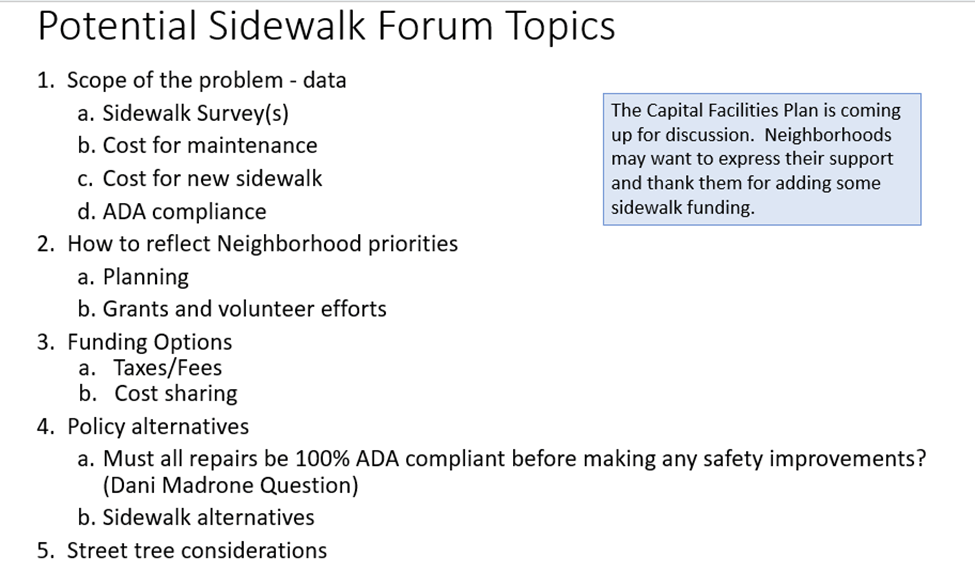
The value added by neighborhoods are helping setting priorities, planning, possible grants and volunteer labor. Neighborhoods know more about their sidewalks than any consultant will — how they’re used, where their problems may be seasonal etc.
Also, we can provide input on preferred ways of raising revenues for sidewalks as well as any cost sharing issues.
Larry referenced topics that might benefit from a community conversation such as a policy issue raised by Dani Madrone at a meeting about moving forward with improving damaged sidewalks and not waiting until the resources are available to meet the updated ADA requirements. Similarly, sidewalk alternatives instead of the standard concrete may be cheaper and suitable for some neighborhoods. Also, trees and damage they make on sidewalks should benefit from a broad discussion. There are lots of pushes and pulls on the direction the city faces.
Larry asked for people to step forward if they are willing to pitch in on the pre-work on the ideas and policy development in order educate ourselves and our neighbors about the issues and let him know by email. Also, if they are willing to pitch in on the day of the meeting (when ever that is locked down) to help with the logistics, sound system etc. And we will need a robust “get the word out” effort to reach as many people as possible. One idea is working with the local schools who share an interest in safe sidewalks and Intercity Transit.
Bob Jacobs raised the type of sidewalk problem of alignment, where the sidewalks don’t line up.
John Saunders stated that part of the problem statement should be a description of the current funding to help people understand the gap between the problem that we’ve got and the funding that exists now.
Mike Ruth made a presentation going over the details and operations of the Sidewalk App Alpha version and asked for feedback and questions. Larry showed what he recorded in his neighborhood.
In response to the city having access to the data the intent is this will be complementary to their GIS. It was also pointed out that this data can be overlayed with other pieces of data that is available publicly from the county, from the city and census information.
The value-added neighborhoods can provide goes beyond an engineering look at sidewalks. How and when and under what conditions is local knowledge. Whether it is using the sidewalks at night or in adverse weather conditions (snow being piled up on sidewalks, flooding inadequate lighting at critical or dangerous points, etc.) those who walk it regularly know more about the situation than any snapshot taken by experts.
Larry reiterated that the kinds of things that you believe are important to capture from your experience of these sidewalks is the feedback that is needed. It is not the actual collection of data right now, it is just an alpha test of the application.
Jim Lazar pointed out that prior to automating meter reading, the city had eyes on the neighborhood that they no longer do.
John Saunders asked when we will be asking people to collect the data. Mike replied that we hope we can use the data we collect now but to guarantee that it will be the same 6 months from now or 3 months from now is not realistic. Larry said that there is a big caveat that if we come up with an important question that’s not currently on the list the picture will be there, the geocode will be there, the GPS coordinates will be there, but it is not necessarily mean that the data would be usable without more work. John suggested we wait until the application is stable before calling for the collection and Mike concurred that it needs a few more test cycles.
Larry stated that the capital facilities plan (CFP) is up for review in the next few weeks, and it would be a good to let the city know we applaud the work that’s been done recently to address the sidewalk issues.
7:40 – 7:50 Draft recommendation on changes to matching grant program
Larry introduced the grant topics and the need to create a subcommittee to draft neighborhood grant changes and potential topics. He pointed out and reviewed Peter Guttchen’s list of proposed changes and said he spoke with Lydia Moorehead about them and a couple of more.
Timing of grants. It was a consensus at our last meeting that the timing is not great. Another issue is the amount of funding; it’s been stuck at $23,000 a year for a long time and requests exceed budget. Lacey has 3 times that amount for just for HOAs.
Non-adult volunteers. Another issue is the confusing guidance regarding the use of non-adult volunteers which is a big problem when trying to engage students.
Insurance. This seems to be a bigger problem in the non-HOA RNAs. Peter Guttchen volunteered to do more work on whether the insurance is useful in practice.
Grant Application Software. The problems in using the existing grant application system which relies on emailing Adobe Acrobat forms was earlier identified as a problem and Larry reported that Lydia is going to pursue using a dedicated application called Submittable for the NMG program.
Advances versus reimbursements. The issue of having to lay out the money ahead of the grant was raised. It is a problem for some RNA’s.
Larry called for volunteers noting that Peter Guttchen already volunteered to be a team member.
7:50 – 8:10 Discussion of Upcoming MOU Study Session
Larry said that the MOU discussion coming up on October 24 may allow RNA members to speak but that has not been finalized yet. He said we need to be prepared to speak to the positive values neighborhood associations bring to Olympia. Larry’s PowerPoint (below) gave some examples.
Larry asked members to share additional examples of how RNAs make Olympia a better place to live.
A discussion was had about addressing the longstanding criticism of RNAs not being representative. Larry requested that it would be helpful for RNAs to share their outreach efforts with him by email.
The conversation moved to how to engage more renters. Jenn Wulf noted that most of the people downtown are renters and found the criticism very frustrating. She said when doing work on tenant advocacy, it’s very difficult to get a response from tenants for lots of reasons.
One suggestion is that all associations check their bylaws to make sure that both renters and owners are eligible for membership in the association.
Another is to not rely only on existing email lists to communicate. Several RNAs said that they now go door-to-door and put fliers on people’s doors, put-up notices on signs on fences and mailboxes and sandwich boards. Many find it’s the best way to reach people you don’t know who live in your neighborhood. Other ideas included,
- Getting a registry of renters from the city
- Requiring landlords to provide info about RNAs to their renters
- Work with local schools on shared interests, like sidewalks and parks
- Providing childcare at meetings
- City grants for subsidies to encourage participation
8:25 – 8:30 Approval of Minutes and Ideas for October
The minutes were approved.
Ideas for future meetings were discussed. They included:
- Having Rebekha Ziesmer from the Olympia Police to speak on topics including traffic issues and maybe include deputy police chief Sam Costello who spoke at our last meeting.
- A desire to return to in-person or hybrid meetings was shared.
- Bob Jones requested a copy of the recent MOU.
- Gerald Apple suggested what other communities are asking for in their grant requests to provide ideas to us.
- John Saunders suggested an agenda item regarding the comprehensive plans and City and County Commission regarding the climate action plan. Judy Bardin said that Dani Madrone chairs the sea level rise response group. Larry agreed to reach out and see if a presentation could be arranged. Sea Level Rise Report Link
- Jenn Wulf, through the Zoom chat, suggested doing a CNA sponsored renter event that would discuss new ordinances and laws that protect tenants that passed recently.
 Council of Neighborhood Associations